

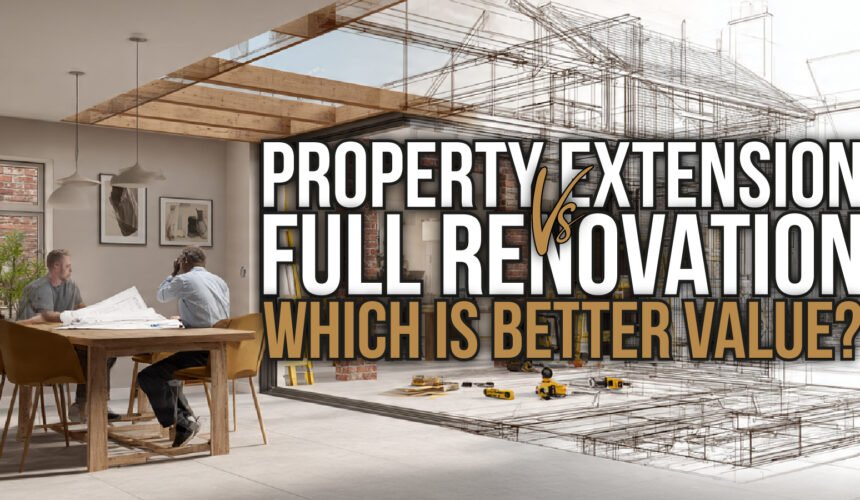
If you own a property in the UK and you’re thinking about upgrading it, you will almost always face the same big decision:
Should you extend your home — or completely renovate it?
Both options can add serious value, improve comfort and transform how you live in your space.
But from a pure value and return point of view, the right choice depends on far more than just budget.
In this guide, we break down:
- real UK cost ranges
- value and resale impact
- planning and compliance
- disruption and build risk
- which option suits different property types
…and help you decide what actually gives better value for your situation.
If you are already planning a project, you can explore professional support through
👉 https://gohaychservices.co.uk/
👉 https://gohaychservices.co.uk/services/
👉 https://gohaychservices.co.uk/get-a-quote/
Understanding the real difference
Before comparing value, it is important to be clear about what each option really means.
Property extension
An extension creates new floor area.
This may include:
- rear extensions
- side extensions
- wrap-around extensions
- loft conversions
- double-storey additions
You are physically increasing the size of the building.
Full renovation
A full renovation upgrades and reconfigures your existing space without expanding the building footprint.
This usually involves:
- full strip-out and refit
- structural alterations inside the property
- new electrics and plumbing
- insulation and energy improvements
- layout redesign
What does “better value” actually mean?
For most UK homeowners and landlords, value is not only about resale price.
Better value normally includes:
- improved long-term livability
- running cost reduction
- maintenance savings
- market appeal
- planning and build risk
- disruption and time cost
The cheapest project is not always the best value project.
Option 1 – Property extensions
Typical UK extension costs
Most homeowners underestimate extension costs.
Current realistic ranges:
| Type of extension | Typical cost per m² |
|---|---|
| Single storey | £1,800 – £2,800 |
| Double storey | £2,000 – £3,200 |
| Loft conversion | £1,400 – £2,500 |
This does not include professional fees, surveys, planning support or landscaping.
Where extensions add the most value
Extensions tend to offer the strongest financial return when:
- the local market rewards larger floor area
- the property has unused garden or side access
- neighbouring properties already have similar extensions
- the extension creates an extra bedroom or second reception
In many suburban and commuter-belt locations, a well designed extension can significantly lift valuation.
Advantages of extending
1. You gain new living space
This is the single biggest advantage.
You are not reshuffling rooms — you are creating new ones.
2. Family growth and lifestyle flexibility
Extensions work particularly well for:
- growing families
- home offices
- open-plan kitchen living spaces
- multigenerational living
3. Strong market visibility
Buyers immediately understand additional square footage.
Limitations of extensions
1. Higher structural risk
Ground conditions, drainage, foundations and access all introduce build complexity.
2. Planning uncertainty
Even permitted development rules still require strict compliance.
Many homeowners rely on guidance from
Planning Portal
before starting.
3. Not always cost-efficient
If the existing house layout remains inefficient, an extension can simply create more poorly organised space.
Option 2 – Full property renovation
Typical UK renovation costs
Renovation costs vary heavily depending on property age and condition.
| Level of renovation | Typical cost per m² |
|---|---|
| Moderate upgrade | £900 – £1,400 |
| Major refurbishment | £1,300 – £2,200 |
| Full strip-back renovation | £1,800 – £2,700 |
These figures often include:
- new wiring and consumer units
- plumbing and heating upgrades
- internal structural changes
- new kitchens and bathrooms
- flooring and finishes
Where renovation offers better value
Renovation becomes better value when:
- the building layout is outdated
- services are nearing end of life
- insulation and efficiency are poor
- the property has strong existing floor area
If you already have enough space, fixing how the space works usually delivers higher real-world value than adding more.
Advantages of full renovation
1. Major improvement to comfort and efficiency
A modern renovation allows you to improve:
- insulation
- heating systems
- glazing
- ventilation
This reduces ongoing costs and future compliance risk.
2. Lower planning exposure
Most internal works avoid planning permission altogether (subject to building control).
3. Better long-term reliability
A renovated building is effectively reset for many years.
Limitations of renovation
1. No increase in floor area
If space is your main problem, renovation alone may not solve it.
2. Hidden defects
Older homes often reveal:
- asbestos
- outdated drainage
- structural defects
- damp problems
These must be addressed once uncovered.
Value comparison – extension vs renovation
Capital return potential
| Factor | Extension | Renovation |
|---|---|---|
| Increases floor area | ✔ | ✖ |
| Improves layout | Limited | ✔ |
| Improves efficiency | Partial | ✔✔ |
| Market appeal | ✔✔ | ✔✔ |
| Risk level | Higher | Medium |
Extensions often deliver bigger headline valuation increases.
Renovations deliver stronger underlying asset quality.
Disruption and project duration
| Project | Typical duration |
|---|---|
| Single storey extension | 12 – 18 weeks |
| Double storey extension | 16 – 26 weeks |
| Full renovation | 8 – 20 weeks |
Renovations can often be completed faster than extensions, especially where groundworks are complex.
Cost predictability
Renovations usually allow more accurate cost forecasting than extensions because:
- the existing structure is already known
- access and logistics are simpler
- fewer unknown ground risks exist
Which option works best for different property types?
Terraced and period homes
Renovation frequently delivers better value because:
- layout improvements unlock space
- thermal performance upgrades are badly needed
- extensions may be restricted by neighbours and planning constraints
Semi-detached and detached houses
Extensions become more attractive where:
- side access exists
- garden depth allows sensible layouts
- parking and access are unaffected
Buy-to-let and investment properties
Full renovation often delivers stronger yield improvements through:
- compliance upgrades
- lower maintenance exposure
- improved tenant demand
Professional property professionals often use valuation guidance from
Royal Institution of Chartered Surveyors
when assessing refurbishment and development uplift.
Planning and compliance considerations
Extensions must comply with:
- local planning policy
- permitted development thresholds
- building regulations
- party wall obligations where applicable
Renovations primarily focus on:
- building control approval
- fire safety compliance
- electrical and gas certification
- insulation and ventilation standards
Both routes still require proper professional oversight.
Long-term running costs
Renovations usually outperform extensions in:
- EPC improvement
- heating demand reduction
- moisture and ventilation control
An extension can add new space, but if the rest of the building remains inefficient, total energy demand often rises.
The biggest mistake homeowners make
The most common mistake is choosing based on budget alone.
The correct starting question should be:
What problem am I actually trying to solve?
- Lack of space → extension may be justified
- Poor layout and condition → renovation often delivers better value
- High running costs → renovation wins
- Family growth and lifestyle needs → extension may be essential
Can you combine both?
In many successful projects, the best value comes from a hybrid approach:
- modest extension for spatial need
- comprehensive renovation for performance and layout
This avoids creating expensive new space attached to an outdated building.
Extension vs renovation – quick decision guide
Choose an extension if:
- you genuinely need additional rooms
- neighbouring properties already extend
- your existing layout already works well
- your plot supports sensible development
Choose full renovation if:
- your layout is inefficient
- services are outdated
- insulation and comfort are poor
- you already have enough total space
How professionals assess “better value”
A professional assessment looks at:
- local sale evidence
- maximum resale ceiling
- build cost vs valuation uplift
- compliance risk
- long-term maintenance exposure
This is why engaging experienced property maintenance and refurbishment specialists early is critical.
You can explore available refurbishment and maintenance services here:
👉 https://gohaychservices.co.uk/services/
Real-world example
A typical three-bed semi-detached home:
Option A – Rear extension only
- Build cost: £55,000 – £70,000
- Valuation uplift: £40,000 – £70,000
- Running cost improvement: limited
Option B – Full renovation and reconfiguration
- Build cost: £40,000 – £60,000
- Valuation uplift: £25,000 – £45,000
- Running cost improvement: high
Option A looks stronger on paper.
Option B often delivers better long-term value and lower risk.
Which is better value for you?
There is no universal answer — but there is a correct one for your property.
The right decision depends on:
- your location
- your plot constraints
- your existing building condition
- your future plans
- your exit strategy (sale, rental, long-term living)
Final verdict
Property extensions usually offer higher visible resale uplift.
Full renovations usually offer stronger asset quality, efficiency and reliability.
For many UK homeowners, a well-planned renovation provides better overall value than an extension — unless additional space is genuinely required.
Get professional advice before you commit
If you are considering either option, getting a proper assessment can prevent costly mistakes and design inefficiencies.
You can speak to a specialist team and request a tailored quotation here:
👉 https://gohaychservices.co.uk/
👉 https://gohaychservices.co.uk/get-a-quote/
A clear scope, realistic budget and structured build plan will always deliver better value than choosing a solution based on price alone.