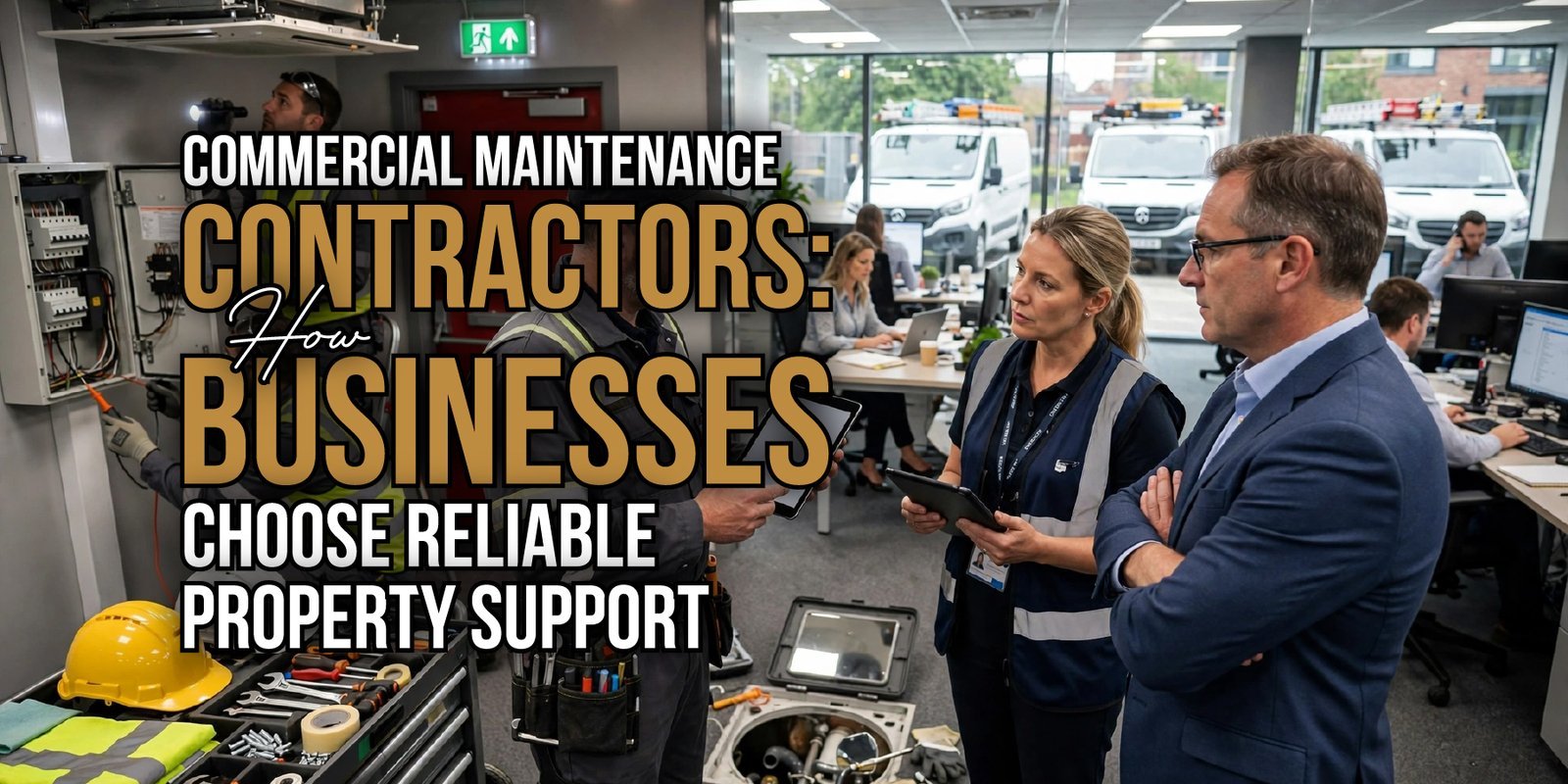
A facilities manager may face a recurring plumbing issue, electrical repairs, overdue planned maintenance and several contractor contacts in the same week. The challenge is not simply finding someone who can repair things; it is choosing commercial maintenance contractors that fit the building, repair volume, operating needs and reporting expectations.
For this reason, commercial maintenance contractors should be compared around service scope, planned and reactive capability, trade coordination, communication, authorisation and reporting. The right arrangement helps a business manage maintenance as a system rather than as a collection of disconnected jobs.
What Do Commercial Maintenance Contractors Do?
Commercial maintenance contractors coordinate and complete agreed property-maintenance work for business premises. Depending on the scope, this can include planned maintenance, reactive repairs, inspections, electrical and plumbing work, general building repairs, cleaning, specialist works and maintenance reporting.
At Gohaych Services, current first-party information supports reactive maintenance, emergency call-outs, planned preventative maintenance, inspections, cleaning, electrical and plumbing work, general repairs, property management, refurbishment and wider building projects.
Commercial Maintenance Services
| Service | What It Covers | When Businesses May Need It |
|---|---|---|
| Reactive repairs | Faults and reported issues | When an issue needs attention |
| Planned preventative maintenance | Scheduled upkeep | For recurring property needs |
| Inspections | Condition and maintenance reviews | To identify priorities |
| Electrical work | Repairs, upgrades and related work | For electrical requirements |
| Plumbing work | Leaks, faults and repairs | For plumbing issues |
| General repairs | Fixtures, finishes and building work | For day-to-day defects |
| Building fabric | Walls, roofs and internal/external elements | For fabric issues |
| Cleaning | Commercial or scheduled cleaning | For routine property care |
| Refurbishment support | Larger improvement works | When repairs become projects |
| Specialist projects | Work requiring specialist expertise | When routine maintenance is not enough |
How Do Businesses Choose Commercial Maintenance Contractors?
Businesses should choose commercial maintenance contractors by comparing relevant service capability, property experience, trade coverage, planned and reactive support, reporting, communication, insurance or credentials where appropriate, response arrangements, quote scope and contract terms.
Price matters. However, it should be compared alongside what the contractor will actually deliver.
A practical selection framework is:
PROPERTY → NEEDS → TRADE COVERAGE → PLANNED + REACTIVE SUPPORT → COMMUNICATION → REPORTING → QUOTE SCOPE → TERMS → REVIEW
Start With Your Property Maintenance Requirements
Before approaching commercial maintenance contractors, define the property type, number of sites, operating hours, recurring issues, planned tasks, reactive requirements and specialist work.
For example, offices and warehouses may need different trades, access arrangements and planned-maintenance priorities.
What Services Should a Commercial Maintenance Contractor Provide?
A property maintenance contractor should match the building and agreed scope. Commercial maintenance contractors should state what they deliver directly, what may require specialist input, how work is authorised and how progress is reported.
No provider needs to self-perform every possible trade. Instead, the business should understand how additional expertise is coordinated when required.
What Should You Look for in a Property Maintenance Contractor?
When comparing a property maintenance contractor, review relevant experience, service breadth, communication, reporting, scheduling, trade coordination, planned-maintenance capability, reactive support, quote clarity and escalation.
Commercial maintenance contractors are easier to compare when every provider receives the same brief. Therefore, document the property, maintenance categories, operating constraints and expected reporting before requesting quotes.
Single Contractor vs Multiple Maintenance Contractors
Some businesses prefer one main contractor, while others use several specialists. Neither model is universally better.
| Factor | Single Main Contractor | Multiple Specialist Contractors |
|---|---|---|
| Coordination | One main route | Business coordinates several suppliers |
| Communication | More centralised | Several contacts |
| Specialist expertise | May coordinate specialist input | Direct access to specialists |
| Reporting | Potentially consolidated | Often separate |
| Scheduling | Central coordination | Separate calendars |
| Administration | Fewer supplier relationships | More supplier management |
| Portfolio complexity | Useful where several needs overlap | Useful where specialist scopes dominate |
Commercial maintenance contractors can add value when they simplify coordination without hiding responsibility or scope.
Why Planned Preventative Maintenance Matters
Planned preventative maintenance gives commercial maintenance contractors a forward-looking structure rather than waiting for every issue to become reactive.
A useful cycle is:
INSPECT → PLAN → SCHEDULE → COMPLETE → RECORD → REVIEW
This can improve maintenance visibility, support budget planning and help facilities teams identify recurring needs. However, planned maintenance does not guarantee lower costs or eliminate future repairs.
Gohaych Services currently describes planned preventative maintenance as part of its property-management offering alongside reactive maintenance and inspections.
What Should a Planned Maintenance Programme Include?
A planned programme should identify building elements or assets, recurring tasks, inspection schedules, responsible trades, service records, priorities, follow-up actions and reporting.
Frequencies should reflect the building, manufacturer information, relevant legal requirements and professional advice where applicable.
At Gohaych Services, current property-management information supports planned preventative maintenance alongside reactive support, inspections and wider property services.
How Should Commercial Repair Contractors Handle Reactive Work?
Commercial repair contractors should use a clear process from initial report to completion.
A practical workflow is:
ISSUE REPORTED → PRIORITY ASSESSED → AUTHORISATION → TRADE ASSIGNED → WORK COMPLETED → RECORD UPDATED → RECURRING ISSUE REVIEWED
Commercial maintenance contractors should also distinguish between a one-off fault and a recurring issue that may require investigation or planned work.
Planned vs Reactive Maintenance
Planned maintenance is scheduled around known upkeep requirements, while reactive maintenance starts after an issue or fault is reported. Commercial properties often need both because planned work supports ongoing condition while reactive work addresses issues arising between scheduled tasks.
| Factor | Planned Maintenance | Reactive Maintenance |
|---|---|---|
| Trigger | Schedule or identified need | Reported issue |
| Timing | Agreed in advance | When action is required |
| Typical work | Inspections and scheduled upkeep | Faults and repairs |
| Scheduling | Predictable | Less predictable |
| Budget planning | Easier to forecast | More variable |
| Reporting | Maintenance history | Repair history |
Commercial maintenance contractors should connect the two so repair history can inform future planning.
What Building Maintenance Services Might a Business Need?
Building maintenance services can include electrical work, plumbing, general repairs, building-fabric work, inspections, planned upkeep, cleaning, refurbishment support and broader property projects.
At Gohaych Services, we support businesses with day-to-day repairs, reactive maintenance and planned preventative maintenance. Current first-party information also supports professional inspections, commercial cleaning, electrical and plumbing work, general building and renovation services, interior upgrades and exterior improvements.
When Should a Business Outsource Property Maintenance?
A business may outsource maintenance when internal teams lack capacity, several trades need coordination, reactive issues repeat, multiple sites require support or maintenance administration is consuming too much management time.
Outsourcing can also help where the organisation wants one reporting route for planned and reactive work.
Businesses considering this model can review outsourced property maintenance to understand how external coordination can support repairs, planning and reporting.
Gohaych’s current outsourced-maintenance guidance specifically covers reactive repairs, planned maintenance, inspections, cleaning, electrical/plumbing work, reporting and specialist escalation.
For portfolios with several maintenance categories, commercial maintenance contractors can reduce the number of separate contractor relationships the internal team must manage.
Why Contractor Coordination Matters
Commercial maintenance often involves plumbers, electricians, general builders, cleaners, specialist contractors, property managers and facilities teams. Without coordination, schedules, approvals and reporting can become fragmented.
A central maintenance arrangement can simplify communication by giving the business one route for repair requests, scheduling and records.
Where broader support is needed, external property maintenance support can be compared with internally coordinated contracting.
When Does a Specialist Contractor Need to Be Involved?
Commercial maintenance contractors should recognise when a routine repair moves beyond general maintenance. Persistent water ingress, specialist electrical work, structural concerns, waterproofing or larger refurbishment works may require additional expertise.
The contractor should identify the changed scope and obtain appropriate authorisation before specialist work proceeds.
When Routine Repairs Are Not Enough
Recurring basement or water-ingress problems may require investigation rather than repeated surface repairs.
Where the property and location make it relevant, businesses can review specialist basement waterproofing in Hounslow as an example of work that sits beyond routine property repair. Gohaych currently publishes dedicated guidance around commercial basement waterproofing in Hounslow.
Commercial maintenance contractors should know when to stop treating a symptom as a standard repair and recommend a separately scoped specialist project.
What Should a Commercial Maintenance Contract Include?
A commercial maintenance contract should clarify the properties covered, services included, planned tasks, reactive work, operating hours, contact process, priorities, authorisation, quote requirements, scheduling, reporting, specialist-contractor process, exclusions and review arrangements.
This is an operational checklist rather than legal advice.
Commercial Maintenance Contract Checklist
| Contract Element | What the Business Should Clarify |
|---|---|
| Properties covered | Which buildings or sites are included |
| Services included | Agreed maintenance categories |
| Planned tasks | Scheduled work and responsibilities |
| Reactive work | How reported issues are handled |
| Operating hours | When support is available |
| Contact process | Who reports and receives updates |
| Priority definitions | How work is categorised |
| Authorisation limits | Who can approve work |
| Quotes | When separate pricing is needed |
| Scheduling | How visits are arranged |
| Reporting | Required records |
| Specialist process | How specialist work is escalated |
| Exclusions | What is outside scope |
| Review frequency | How the arrangement is assessed |
How Should Repair Requests Be Prioritised?
Commercial maintenance contractors should use priority definitions agreed with the client.
A high-level model is:
URGENT OPERATIONAL ISSUE → HIGH-PRIORITY REPAIR → ROUTINE REPAIR → PLANNED IMPROVEMENT
The definitions should reflect the building and operating requirements. Businesses should not rely on a universal response-time promise that ignores site-specific circumstances.
Why Repair Authorisation Limits Matter
Businesses should define who can approve work, when a separate quote is required and how urgent escalation works.
Authorisation limits help commercial maintenance contractors understand what can proceed and what requires client approval first.
What Reporting Should Businesses Expect?
Commercial maintenance contractors should provide reporting that lets the client understand what happened and what happens next.
Useful fields can include:
- job reference;
- property;
- issue reported;
- date;
- priority;
- work carried out;
- trade involved;
- completion status;
- follow-up required; and
- recurring-issue notes.
Supporting photographs may also be useful where appropriate.
Why Maintenance Records Matter
Maintenance records help identify repeat faults, plan future work, support handovers and review contractor performance.
For commercial maintenance contractors, consistent records turn individual work orders into useful maintenance history.
How Should Businesses Compare Maintenance Quotes?
Businesses should compare maintenance quotes like for like. Review scope, labour, materials, exclusions, whether work is planned or reactive, specialist trades, timing, reporting and follow-up.
Maintenance Quote Comparison
| Quote Factor | Provider A | Provider B | Provider C |
|---|---|---|---|
| Scope | |||
| Labour | |||
| Materials | |||
| Exclusions | |||
| Specialist trades | |||
| Timing | |||
| Reporting | |||
| Follow-up | |||
| Final quoted cost |
Commercial maintenance contractors should not be judged on one headline number when the scopes differ.
Cheapest Quote vs Best-Fit Contractor
The cheapest quote is not automatically poor, and the most expensive quote is not automatically better.
Businesses should compare:
- scope;
- capability;
- communication;
- reporting;
- service structure; and
- final quoted cost.
Ultimately, commercial maintenance contractors should be judged on fit as well as price.
What Credentials Should Businesses Check?
Businesses may need to verify company details, relevant insurance, trade qualifications, regulated-trade credentials where applicable, risk documentation, references and subcontractor arrangements.
Before appointing commercial maintenance contractors, check credentials relevant to the actual work rather than assuming every maintenance category needs the same qualification.
Commercial Maintenance Contractors for Multiple Properties
For portfolios, commercial maintenance contractors should be able to support central reporting while retaining different priorities for each building.
Multi-site requirements may include planned schedules, reactive repair coordination, contractor allocation and recurring-issue tracking.
Commercial Maintenance Contractors for Offices
Offices may need electrical and plumbing repairs, shared-area upkeep, decorating and refurbishment support.
Commercial maintenance contractors should work around occupancy and access.
Commercial Maintenance Contractors for Retail Properties
Retail sites may need repairs, cleaning and planned work around trading hours.
Commercial maintenance contractors should define scheduling clearly so the business understands when work is expected to happen.
Commercial Maintenance Contractors for Warehouses and Industrial Sites
Warehouses may need building-fabric, electrical, plumbing and inspection support.
Commercial maintenance contractors should understand operational access and site scheduling before work begins.
Commercial Maintenance Contractors for Landlords and Managing Agents
Landlords and managing agents may need multi-property coordination, planned maintenance and reporting.
Commercial maintenance contractors can support consistency while owners and managers retain control of budgets, approvals and property strategy.
How Gohaych Services Supports Commercial Property Maintenance
At Gohaych Services, we support commercial properties with reactive repairs, planned preventative maintenance, inspections and wider building-maintenance requirements.
Current first-party information also supports commercial cleaning, electrical and plumbing work, general repairs, property management, refurbishment and broader construction or improvement work.
For businesses that want a broader arrangement, our outsourced maintenance support for businesses can provide a framework for coordinating planned and reactive work.
Where a property needs more than ongoing maintenance, Gohaych Services also supports renovation, interior upgrades, exterior improvements and wider building projects according to the agreed scope.
Commercial Maintenance Contractors in Hounslow and London
Gohaych Services is based at 18 Neals Corner, 2 Bath Road, Hounslow, Middlesex, TW3 3HJ.
Current first-party information supports commercial, industrial and mixed-use enquiries, London coverage and wider UK support.
Commercial maintenance contractors should still be compared against each building’s trade needs and operating priorities.
Need Reliable Maintenance Support for Your Property?
If your business is reviewing commercial maintenance contractors, prepare the property type, location, number of properties, current issues, planned-maintenance needs, reactive requirements, relevant trades and preferred reporting.
You can discuss your commercial maintenance requirements with Gohaych Services so the proposed scope reflects the actual buildings and priorities.
Common Contractor-Selection Mistakes
Common Contractor-Selection Mistakes Table
| Mistake | Better Approach |
|---|---|
| Choosing only on price | Compare scope and capability |
| Undefined maintenance scope | List included work |
| Mixing planned/reactive needs | Separate requirements |
| No priority process | Define categories |
| No authorisation procedure | Set approval routes |
| No reporting requirements | Agree records |
| No maintenance history | Maintain job records |
| No specialist process | Define escalation |
| Unclear responsibilities | Allocate duties |
| Unclear operating hours | State scheduling constraints |
| No credential review | Check relevant evidence |
| No planned schedule | Build recurring tasks |
| Treating repeat faults as isolated | Review recurring issues |
| Comparing different scopes | Compare like for like |
| No escalation contact | Name decision-makers |
| Unclear subcontracting | Clarify arrangements |
| No performance review | Review periodically |
| Repeated patch repairs | Consider specialist investigation |
Commercial Maintenance Contractors Checklist
Use this commercial maintenance contractors checklist before appointment:
- Confirm property type.
- Confirm location.
- Confirm number of sites.
- List recurring issues.
- List planned maintenance needs.
- List reactive requirements.
- Identify required trades.
- Define emergency contact process.
- Define priorities.
- Define authorisation levels.
- Define quote approval.
- Review trade coverage.
- Review relevant experience.
- Check insurance where appropriate.
- Check trade credentials where applicable.
- Review planned-maintenance capability.
- Review reactive-repair process.
- Review specialist-contractor process.
- Review electrical capability.
- Review plumbing capability.
- Review building-fabric capability.
- Review cleaning requirements.
- Review inspection process.
- Define scheduling.
- Define access arrangements.
- Define communication contacts.
- Define reporting requirements.
- Define completion records.
- Review subcontracting.
- Compare quote scope.
- Review exclusions.
- Review contract terms.
- Review performance periodically.
- Update the maintenance plan as building needs change.
Commercial maintenance contractors should be reassessed when the portfolio, operating hours or maintenance requirements materially change.
Frequently Asked Questions
What do commercial maintenance contractors do?
Commercial maintenance contractors coordinate and complete agreed property-maintenance work for business premises. Depending on scope, they can support planned maintenance, reactive repairs, inspections, electrical or plumbing work, general building repairs, cleaning, specialist projects and reporting. Businesses should confirm which services are included, which may use specialist contractors and how jobs move from request to completion.
How do businesses choose commercial maintenance contractors?
Businesses should compare commercial maintenance contractors by service capability, property experience, trade coverage, planned and reactive support, reporting, communication, credentials where relevant, quote scope and contract terms. Price should form part of the decision, but businesses should compare like-for-like scopes. A contractor that fits the building and operating process may offer more practical value than one chosen only by headline price.
What should a property maintenance contractor provide?
A property maintenance contractor should provide the services agreed for the property, together with clear scheduling, communication, authorisation, reporting and escalation. Depending on the arrangement, that may include planned maintenance, reactive repairs, inspections, trade coordination and specialist escalation. The business should know which responsibilities remain with its facilities or property-management team.
What are commercial repair contractors?
Commercial repair contractors handle repair work for business properties, including reported faults, building repairs and trade-specific issues within their capability. A strong reactive process should assess priority, confirm authorisation, assign the correct trade, complete the work, update records and review repeat faults. Commercial maintenance contractors may coordinate this reactive work alongside planned maintenance.
What building maintenance services do businesses usually need?
Building maintenance services can include electrical and plumbing work, general repairs, building-fabric maintenance, inspections, planned upkeep, cleaning and refurbishment support. The correct mix depends on the building type, condition and use. Businesses should avoid buying a generic package without checking whether the included services match their actual commercial property needs.
What is the difference between planned and reactive maintenance?
Planned maintenance is scheduled around known upkeep requirements, inspections or identified future work. Reactive maintenance starts after a fault or issue is reported. Commercial properties usually need both. Commercial maintenance contractors should connect reactive repair history with planned work so repeat faults can inform future maintenance priorities rather than remain isolated jobs.
Should businesses use one maintenance contractor or several?
Either model can work. One main contractor can simplify coordination, scheduling and reporting, while several specialists can provide direct access to particular expertise. Businesses should compare administration, property complexity, specialist requirements and reporting needs. Commercial maintenance contractors should also explain when they use subcontractors or specialist support so responsibilities remain clear.
What should a commercial maintenance contract include?
A maintenance contract should clarify the properties covered, services included, planned tasks, reactive repairs, operating hours, contact route, priority definitions, authorisation, scheduling, reporting, specialist-contractor process, exclusions and review arrangements. Pricing and quote requirements should also be clear. Businesses should seek appropriate professional advice where they need help with contractual or legal terms.
What reporting should maintenance contractors provide?
Useful reporting can include job reference, property, issue, date, priority, work completed, trade involved, status, completion date, follow-up and recurring-issue notes. Supporting photographs may also be useful where appropriate. Commercial maintenance contractors should agree the reporting format with the client before work begins instead of assuming one generic report suits every business.
How should businesses compare maintenance quotes?
Businesses should compare maintenance quotes on the same scope. Review labour, materials, exclusions, specialist trades, planned versus reactive work, timing, reporting, follow-up and final quoted cost. Commercial maintenance contractors may structure quotes differently, so a lower headline amount should not be treated as directly comparable until the included work and assumptions are understood.
When should a business outsource property maintenance?
A business may outsource maintenance when internal teams lack time or capacity, several trades need coordination, reactive work repeats, multiple properties require support or maintenance administration is becoming difficult to manage. Outsourcing can also create a clearer reporting and scheduling structure. The business should still retain oversight of budgets, approvals, priorities and contractor performance.
How should recurring repair problems be handled?
Recurring problems should be identified in maintenance records and reviewed rather than repeatedly treated as unrelated faults. The contractor should consider whether investigation, planned work or specialist input is required. Commercial maintenance contractors should escalate a recurring issue when the evidence suggests the existing repair approach is not addressing the underlying maintenance need.
Conclusion
Commercial maintenance contractors should be chosen around the property, maintenance needs, planned work, reactive repairs, trade coverage, priorities, authorisation, scheduling, reporting and review.
PROPERTY → NEEDS → PLANNED MAINTENANCE → REACTIVE REPAIRS → TRADE COVERAGE → PRIORITIES → AUTHORISATION → SCHEDULING → REPORTING → REVIEW
Ultimately, commercial maintenance contractors add the most value when they help a business manage maintenance as a connected operating process rather than a series of disconnected repair jobs.
Discuss Your Commercial Maintenance Requirements With Gohaych Services
Gohaych Services can discuss reactive maintenance, planned preventative maintenance, inspections, electrical and plumbing work, general repairs, building maintenance, property management, refurbishment and broader commercial property support.
For a property-specific discussion, request a commercial maintenance quote.