Commercial property value is rarely improved by one dramatic change alone. More often, it rises because the building becomes easier to let, cheaper to run, more attractive to tenants, and more resilient over time.
That matters even more in the UK, where occupiers, landlords, and asset managers are weighing running costs, presentation, compliance, flexibility, and lease appeal much more carefully than before. A tired building can still perform, however a well-planned upgrade strategy often helps it compete better, protect income, and support stronger long-term returns.
The smartest approach is not to throw budget at finishes that look impressive for a few months. Instead, it is to focus on commercial property upgrade ideas that increase value in practical ways. That may mean better frontage, more efficient lighting, upgraded washrooms, layout improvements, access control, or maintenance-led works that reduce future disruption.
For UK commercial property owners, investors, facilities managers, and landlords, the key question is simple. Which upgrades genuinely improve value, and which ones only look good on paper?
Why commercial property upgrades matter in the UK
In the UK market, commercial buildings are judged on more than square footage and postcode. Tenants and buyers increasingly assess first impressions, operating costs, energy performance, flexibility, security, condition, and the likely maintenance burden after occupation.
Because of that, even modest works can have a meaningful commercial effect. A cleaner entrance, more modern reception, improved lighting, and upgraded washrooms may not transform a poor asset into a prime one. They can, however, improve perception quickly and reduce objections during viewings.
Meanwhile, deeper upgrades such as heating, cooling, insulation, access control, and layout modernisation often strengthen long-term asset performance. They may also support better retention, fewer complaints, lower void risk, and improved operational efficiency.
In addition, UK landlords often face a familiar challenge. They need to balance capital spend against uncertain payback. That is why upgrade planning should connect directly to tenant profile, building condition, local demand, lease strategy, and the realistic positioning of the asset in its market.
What makes a commercial property upgrade increase value
Not every improvement increases value in the same way. Some upgrades support valuation more directly, while others mainly improve tenant appeal, speed up letting, reduce void periods, or lower lifecycle costs.
A value-driving commercial upgrade usually does one or more of the following:
- improves first impressions and marketability
- supports stronger rent potential or lease appeal
- reduces maintenance risk and future repair costs
- lowers running costs through efficiency improvements
- improves flexibility for incoming tenants
- strengthens safety, security, and operational practicality
- helps the building compete better within its local market
Cosmetic improvements can still matter. A fresher reception or better flooring may help create momentum in a viewing and reduce the sense that the building will require immediate spend. However, cosmetic work alone often has limits.
By contrast, upgrades that solve real problems tend to create stronger value. For example, unreliable heating, poor lighting, dated washrooms, weak access control, damaged frontage, or inflexible layout can all suppress appeal. When those issues are fixed properly, the building becomes easier to occupy, manage, and retain.
Therefore, the most effective projects usually combine presentation with practicality.
The best upgrade ideas for increasing commercial property value
The strongest improvement strategy depends on the asset. An office, retail unit, industrial building, or mixed-use property will not benefit from exactly the same priorities. Even so, some upgrade categories consistently matter across UK commercial buildings.
Entrance and frontage upgrades
First impressions shape perceived value quickly. Before a tenant reviews the lease or fit-out potential, they see the exterior, entrance route, door condition, lighting, signage, glazing, and general upkeep.
Frontage upgrades that often perform well include:
- redecorating tired external areas
- repairing cladding, render, or damaged surfaces
- improving entrance doors and glazing
- upgrading external lighting
- replacing worn canopy, paving, or threshold finishes
- improving wayfinding and visible building identity
For retail, frontage is particularly important because it affects footfall perception and brand confidence. For offices, it signals professionalism. For industrial or trade assets, it still matters because occupiers and visitors notice whether the site feels secure, organised, and maintained.
A neglected entrance can create doubt about the rest of the building. Conversely, a clean, modern, well-lit arrival point helps reduce friction early.
Reception and first-impression areas
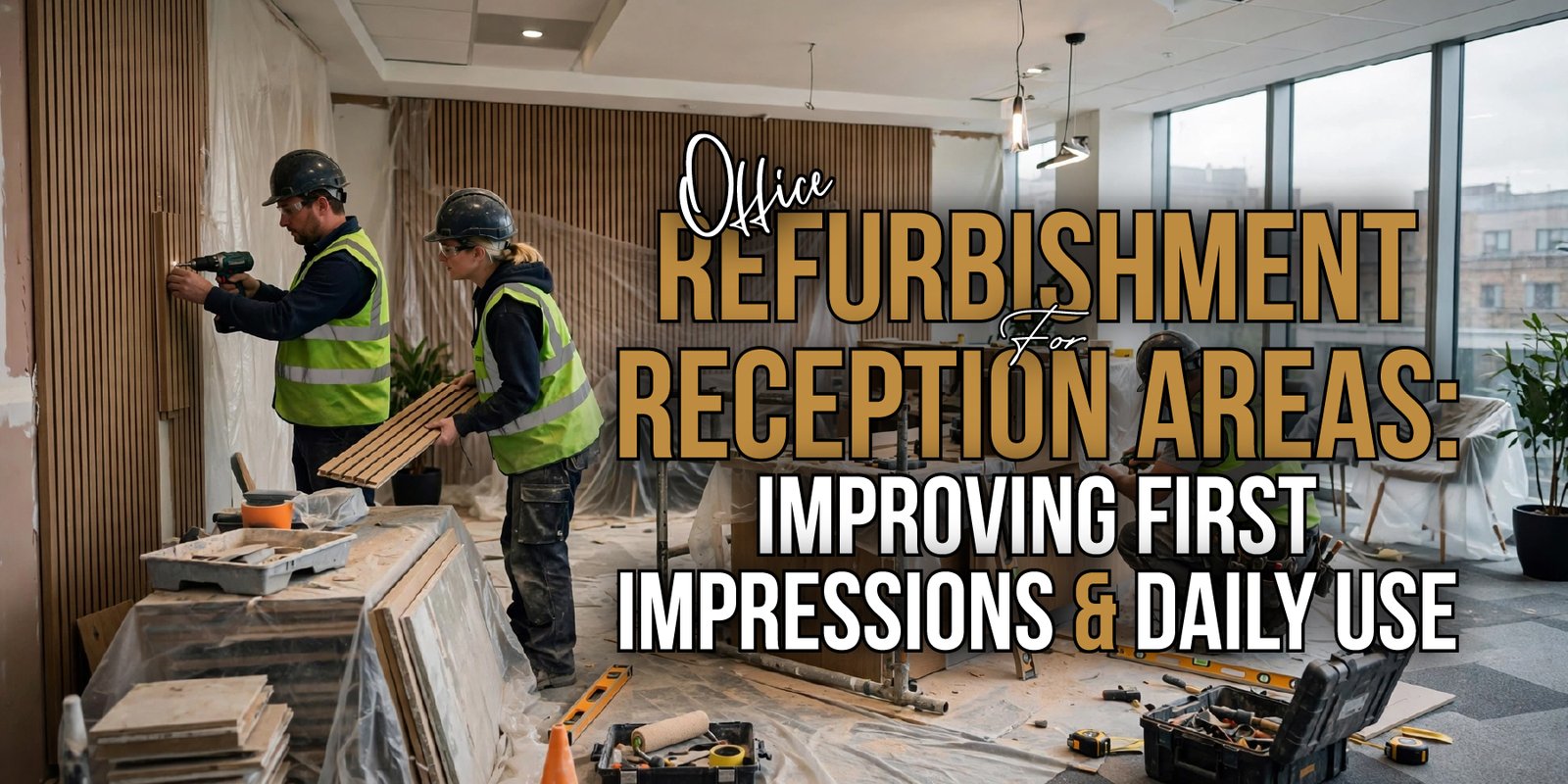
Reception areas influence how a commercial building is experienced. Even where reception is modest, it should feel functional, clean, and aligned with the building’s target occupier.
Value-supporting reception upgrades may include:
- replacing dated desks or wall finishes
- improving lighting and signage
- refreshing flooring and ceilings
- introducing durable finishes that are easy to maintain
- improving visitor flow and access control
In multi-let offices, the reception often carries disproportionate weight. It frames the building standard before occupiers see the individual suites. As a result, a tired reception can undermine otherwise decent space.
Common area refurbishment
Shared corridors, stairwells, lift lobbies, and breakout zones affect how the whole asset feels. Because they are repeatedly used, deterioration becomes obvious quickly.
Commercial property owners often gain more from improving common areas than from overspending inside one vacant suite. Better paintwork, more durable flooring, upgraded lighting, improved handrails, fresh doors, and cleaner wayfinding can lift the whole building standard.
Moreover, common area upgrades help tenant retention because they improve the daily user experience rather than only the marketing image.
Washroom upgrades
Washrooms are one of the clearest indicators of whether a building has been maintained properly. Tenants notice cleanliness, fixtures, lighting, ventilation, durability, and general condition almost immediately.
A washroom refurbishment can improve perceived quality far more than many owners expect, especially in offices, hospitality-linked assets, and customer-facing commercial spaces.
Good-value washroom improvements often include:
- modern sanitaryware and fittings
- better ventilation
- easier-clean wall and floor finishes
- improved cubicles and vanity areas
- sensor taps or water-saving fixtures
- upgraded lighting and mirrors
Although washrooms are not always a headline marketing feature, poor ones can damage confidence fast. Therefore, upgrading them often removes a major barrier to letting.
Lighting upgrades
Lighting affects appearance, comfort, productivity, safety, and energy use. It is one of the most practical commercial refurbishment ideas that add value because it touches both tenant appeal and operating efficiency.
LED upgrades, improved controls, and better layout can help:
- brighten dark receptions and corridors
- reduce energy use
- improve working conditions
- support security inside and outside the building
- modernise tired space without major structural work
For example, an older office with yellowing, uneven lighting may feel dated even if the space itself is sound. Meanwhile, a brighter and more consistent lighting scheme can make the same unit appear larger, cleaner, and more usable.
Flooring improvements
Flooring has a direct effect on presentation, maintenance, and durability. Worn carpet, cracked tiles, stained vinyl, or uneven transitions can make a building feel neglected.
However, the best flooring choice depends on use. Offices may benefit from durable carpet tiles or high-quality vinyl. Retail may require finish, resilience, and easy maintenance. Industrial environments often need more robust, safety-led flooring solutions.
The key is not to choose the most expensive finish. It is to select flooring that suits footfall, cleaning demands, replacement cost, and visual positioning.
Overspending here can weaken ROI, particularly if the finish is too premium for the local market or likely occupier.
Energy-efficiency improvements
Energy efficiency is no longer a side issue. In the UK, running costs and building performance increasingly influence leasing conversations, asset strategy, and long-term competitiveness.
Depending on the building, worthwhile energy-efficiency improvements may include:
- LED lighting and controls
- insulation improvements
- draught reduction
- upgraded windows and doors
- smarter heating controls
- improved building management systems
- more efficient plant and equipment
These works may not always create instant headline valuation uplift. Even so, they can improve occupier confidence, reduce operating costs, support compliance positioning, and strengthen appeal for cost-conscious tenants.
In addition, buildings with poor performance can face more resistance in the market. That makes efficiency-led upgrades commercially relevant even when the payback is gradual.
Heating and cooling upgrades
Heating and cooling issues can damage both value perception and tenant experience. If a building is too cold, too hot, unreliable, or expensive to run, interest may fall quickly.
Commercial heating and cooling upgrades might involve:
- replacing ageing HVAC systems
- improving zoning and controls
- upgrading ventilation
- addressing comfort imbalances
- reducing maintenance-heavy plant issues
Because comfort affects daily occupancy, these works often matter more than cosmetic upgrades. They may also reduce complaints, improve retention, and support better use of the space year-round.
Signage improvements
Clear, professional signage supports branding, wayfinding, and first impressions. Although it is rarely enough on its own to create value, it often strengthens the effect of other upgrades.
Signage matters especially in multi-let buildings, serviced environments, retail locations, and business parks. Better external and internal signage can make a property feel more organised, easier to navigate, and better managed.
Security upgrades
Security improvements can influence both tenant appeal and operational confidence. This is particularly true for offices with shared access, retail premises, industrial sites, and mixed-use buildings.
Practical upgrades may include:
- access control systems
- CCTV improvements
- better external lighting
- door entry upgrades
- secure perimeter measures
- improved alarm integration
Security spending should be proportionate. However, visible and sensible upgrades can reassure occupiers, reduce risk exposure, and support smoother building management.
Accessibility improvements
Accessibility should not be treated as an afterthought. Better access can widen occupier appeal, improve usability, and reduce friction for staff, visitors, and customers.
Depending on the building, improvements may include:
- step-free access adjustments
- entrance changes
- lift upgrades
- clearer signage
- wider circulation routes
- accessible washroom improvements
In some buildings, these works are essential before aesthetic upgrades make sense. If a property feels difficult to access, expensive finishes will not solve the underlying problem.
Layout modernisation
Older layouts can limit value if they no longer fit current occupier needs. Rigid partitions, wasted circulation space, awkward receptions, poor meeting provision, or weak service distribution can all reduce appeal.
Layout modernisation may help by:
- improving natural flow
- creating more flexible working zones
- increasing usable area perception
- making the space easier to adapt for future tenants
This is especially relevant for offices and certain mixed-use assets. Still, layout changes should be evidence-led. A costly reconfiguration with no clear occupier logic can quickly become overspend.
Upgrades that improve tenant appeal and lettability
Some works do not necessarily produce dramatic valuation shifts, yet they can still be commercially powerful because they help the property let faster and more confidently.
Tenant appeal often improves through:
- better presentation at entry points
- cleaner and more modern shared areas
- reliable heating, cooling, and lighting
- upgraded washrooms
- practical signage and access
- improved security and ease of use
- more flexible layout options
For a landlord, that matters because lettability affects income stability. A building that attracts stronger interest, receives fewer objections, and creates a better viewing experience is often easier to position in the market.
Consider two similar office units in the same town. One has dated common areas, poor lighting, tired washrooms, and unclear access. The other has a cleaner frontage, refreshed reception, LED lighting, modernised washrooms, and better access control. The second may not command a radically different valuation overnight, however it is more likely to attract viewings, reduce negotiation friction, and support stronger lease confidence.
Therefore, owners should not dismiss upgrades simply because the return is indirect. In many cases, tenant appeal is the bridge to better performance.
Upgrades that strengthen long-term asset performance
The best commercial property improvements for landlords are not always the most visible. Some of the highest-value decisions are the ones that reduce future risk, improve operational resilience, and lower the cost of owning the asset over time.
These often include:
- maintenance-led repairs before deterioration spreads
- roof, drainage, and envelope improvements
- plant upgrades
- better lighting and controls
- durable flooring and finishes
- security and access systems that reduce incidents
- efficiency improvements that lower running costs
Maintenance issues should usually come before decorative upgrades. A polished reception means little if the building suffers from leaks, heating failures, poor ventilation, damaged doors, or repeated repair calls. Moreover, unresolved defects often make later finishes wear faster, which wastes budget.
Long-term value is usually stronger when owners fix core problems early and then improve presentation in the right order.
Upgrades that may not deliver strong return in every case
Not every commercial refurbishment idea is a smart investment. Some works underperform because they are too bespoke, too expensive for the local market, or disconnected from likely occupier expectations.
Examples that may not deliver strong return in every case include:
- ultra-premium finishes in secondary locations
- highly specific design features tied to one brand style
- expensive reception concepts in basic industrial assets
- layout changes that reduce flexibility
- decorative upgrades that ignore maintenance issues
- over-engineered systems that are costly to maintain
For example, a local office building in a price-sensitive market may benefit more from better lighting, practical washrooms, refreshed flooring, and efficient heating than from luxury stone finishes or statement joinery. Similarly, a warehouse unit may gain more from doors, security, external yard condition, and lighting than from cosmetic office embellishments.
As a result, good ROI depends on fit, not just spend.
How value changes by building type and local market
Commercial property upgrade value varies widely across the UK. The same project can perform very differently depending on area, building type, tenant profile, local demand, lease expectations, and the starting condition of the asset.
In London and stronger regional centres, occupiers may expect a sharper standard of reception, common areas, lighting, washrooms, and energy performance. In smaller towns or secondary markets, practicality and affordability may matter more than premium finishes.
Building type also changes the priority list:
Offices
Office occupiers usually notice reception quality, shared spaces, lighting, washrooms, layout flexibility, comfort, and energy performance. Therefore, first-impression and user-experience upgrades often matter most.
Retail units
Retail value is more sensitive to frontage, signage, visibility, lighting, access, and customer-facing presentation. Meanwhile, back-of-house practicality still matters because poor staff areas can affect operations.
Industrial and warehouse buildings
Industrial assets often benefit most from yard condition, lighting, loading access, doors, office support space, washrooms, security, and maintenance-led upgrades. Premium aesthetic finishes are usually lower priority unless the asset targets a higher-spec occupier.
Mixed-use buildings
Mixed-use schemes require balance. Upgrades should support presentation, access, safety, management efficiency, and compatibility across occupier types.
Local demand matters just as much. A business park with strong competition may require sharper presentation to stand out. By contrast, in a constrained market, practical reliability and clean condition may be enough to improve performance significantly.
Ultimately, UK commercial property owners should judge upgrades against the local leasing environment, not against generic design trends.
Common mistakes commercial property owners make
A frequent mistake is focusing on what looks impressive instead of what solves real friction. Good photography may help marketing, however tenants and agents still notice comfort issues, access problems, outdated washrooms, weak lighting, and maintenance concerns.
Other common mistakes include:
Prioritising aesthetics before repairs
Leaks, drainage issues, HVAC faults, damaged doors, and poor lighting should usually be addressed before decorative works.
Overspending on the wrong finish
A finish that exceeds local tenant expectations can reduce return rather than improve it.
Ignoring tenant profile
Professional office occupiers, trade users, retailers, and mixed-use tenants all value different things. Therefore, the upgrade plan should reflect who the likely occupier is.
Treating all value as headline valuation
Some improvements mainly support lettability, retention, and lease confidence rather than a direct capital jump. That still matters commercially.
Underestimating disruption and coordination
Poor sequencing can create avoidable downtime, cost overruns, and patchy quality.
Failing to compare options properly
Owners often commit to a project scope before comparing refurbishment choices and ongoing service needs. In many cases, it helps to review both one-off upgrade works and broader commercial property services before making the final decision.
If you want a clearer view of timings, cost factors, and project benefits, it is worth reading commercial property refurbishment explained before committing budget.
How to prioritise upgrades based on budget, building condition, and business goals
The best way to prioritise is to divide works into three layers.
1. Essential building-condition issues
Start with anything that affects safety, operation, durability, or repeated maintenance cost. This may include roofing defects, drainage, plant failure, access issues, lighting problems, door and window faults, or security weaknesses.
2. Tenant-facing presentation improvements
Next, address the areas that shape first impression and everyday experience. Reception, entrances, common parts, washrooms, signage, flooring, and lighting usually sit here.
3. Strategic performance upgrades
Finally, review the improvements that support long-term competitiveness and efficiency. Heating and cooling upgrades, energy improvements, layout modernisation, and smarter access systems often fall into this category.
This structure helps owners avoid spending heavily on surface-level enhancements while deeper issues remain unresolved.
Budget should also match the business goal. If the aim is to let vacant space quickly, presentation and basic usability may take priority. If the goal is asset repositioning over several years, efficiency, comfort, and broader refurbishment strategy may justify more spend.
Likewise, a landlord preparing for lease renewal may focus on tenant experience and reliability. An investor planning a reposition may look more closely at layout, common parts, frontage, and cost-to-run improvements.
Because each asset differs, comparing scope carefully is essential. Reviewing available commercial property services alongside refurbishment options can help you decide whether the building needs reactive fixes, planned improvements, or a wider upgrade strategy.
Conclusion
The most effective commercial property upgrade ideas that increase value are rarely the flashiest ones. In the UK, the upgrades that usually perform best are those that improve presentation, tenant confidence, running efficiency, durability, and ease of occupation in a balanced way.
Entrance upgrades, common area refurbishment, washroom improvements, better lighting, energy-efficiency measures, heating and cooling upgrades, security improvements, accessibility works, and layout changes can all add value. However, results depend on the building’s condition, local market, tenant expectations, lease structure, budget, and execution quality.
That is why smart decision-making matters more than headline spend. Prioritise the issues that affect usability and performance first, then invest in upgrades that strengthen lettability, long-term asset performance, and market position.
If you are assessing refurbishment projects in the UK and want practical guidance on the right next steps, Gohaych Services can help you review priorities, compare upgrade options, and plan works that make commercial sense for your building. Contact the team to discuss refurbishment, improvement planning, or ongoing support for your commercial property.
- People Also Ask Questions
People Also Ask
What are the best commercial property upgrades in the UK?
The best upgrades usually combine tenant appeal with operational value. In many UK commercial buildings, entrances, washrooms, lighting, flooring, heating, cooling, security, and common area improvements perform well because they improve first impressions, usability, and long-term efficiency.
How do you increase commercial property value?
Commercial property value often improves when the building becomes easier to let, cheaper to run, and more attractive to tenants. That can come from practical refurbishment, maintenance-led improvements, better energy performance, stronger presentation, and upgrades that reduce future operational issues.
Which commercial refurbishment ideas add the most value?
Upgrades that solve visible and functional weaknesses usually add the most value. For example, better frontage, reception improvements, modern washrooms, LED lighting, HVAC upgrades, and access control can improve both tenant confidence and the building’s competitive position.
Do cosmetic upgrades increase commercial property value?
Cosmetic upgrades can help, especially where presentation is holding the building back. However, they tend to work best when core issues such as maintenance, lighting, heating, access, or washroom condition have already been addressed. Presentation alone rarely delivers the strongest return.
What upgrades improve tenant appeal in commercial property?
Tenants are often influenced by entrances, reception areas, common parts, washrooms, lighting, security, comfort, and flexibility. These upgrades improve everyday experience and may support quicker letting, stronger lease confidence, and better tenant retention.
Are energy-efficiency upgrades worth it for commercial buildings?
In many cases, yes. Energy-efficiency upgrades can reduce running costs, improve occupier confidence, and support long-term asset performance. The return varies by building and market, however efficiency is increasingly important in UK commercial property decisions.
Do all commercial buildings need the same upgrade strategy?
No. Offices, retail units, industrial buildings, and mixed-use properties usually need different priorities. Local demand, tenant profile, lease expectations, asset condition, and budget all influence which upgrades are likely to deliver the strongest commercial return.
When should landlords prioritise maintenance over refurbishment?
Landlords should usually prioritise maintenance first when defects affect safety, comfort, performance, or repeated repair costs. Leaks, plant issues, poor lighting, access problems, or worn building elements can weaken the value of later refurbishment if they are left unresolved.