
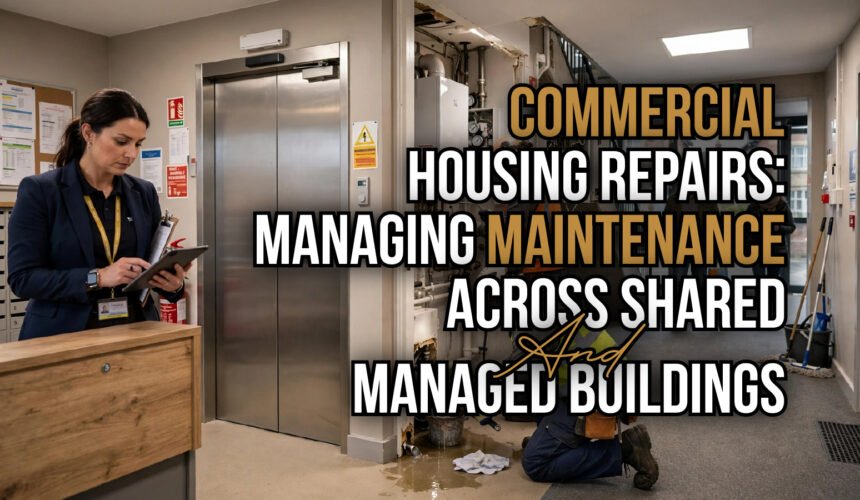
A property manager receives four repair reports from the same building: a hallway light fault, a sticking communal door, damage in a shared area and a tenant access request. None looks difficult alone, but together they need organisation. Commercial housing repairs work better when every issue has a priority, owner, access plan and clear next action.
Shared and managed buildings add extra moving parts because several occupiers may use the same entrances, corridors and facilities. Therefore, commercial housing repairs should connect reporting, inspections, access arrangements, repair scheduling and completion records rather than treating every fault as an isolated job.
This guide is for general business information only and does not replace legal, lease, insurance or compliance advice. Landlords, property owners and property managers should review their own obligations and seek professional guidance where needed.
What Are Commercial Housing Repairs?
Commercial housing repairs can include repair coordination, planned maintenance checks, common-area repairs, landlord support and property repair management across managed residential, mixed-use or commercially managed buildings. The exact scope depends on the property type, tenancy arrangements, access needs, building use and the maintenance responsibilities agreed between the relevant parties.
In practice, work may involve shared entrances, hallways, stairwells, lighting, doors, plumbing issues, external areas, waste areas and visible building-fabric defects. However, specialist systems and regulated work may require appropriately competent professionals.
For commercial housing repairs, the useful starting point is a clear record of what has been reported, where it is located and what should happen next.
Quick Answer: How Should Property Managers Organise Commercial Housing Repairs?
Property managers should record each issue, assess urgency, assign responsibility, plan access, communicate with tenants or occupiers, schedule suitable work, track completion and review recurring problems. Commercial housing repairs become easier to manage when urgent work follows a separate route from planned tasks and every open item has a named owner and next action.
A simple repair log can provide that structure. Most importantly, the process should match the building rather than force every property into the same maintenance schedule.
Why Shared and Managed Buildings Need Clear Repair Management
Shared buildings need clearer repair management because one defect can affect several occupiers, access routes or common facilities at the same time. Commercial housing repairs therefore need consistent priorities, communication and records so different people do not receive conflicting instructions.
Multiple tenants can also create practical questions about access. For example, a hallway repair may not require entry to individual units, while another task may need a specific occupier to be available.
Likewise, responsibility may differ between shared areas, individual units and specialist building systems. For this reason, commercial housing repairs should begin with a responsibility check rather than an assumption.
A structured process also helps managers see recurring faults. Instead of repeatedly responding to the same door, lighting or water-related issue, the repair history can trigger a wider review.
Managed Building Repairs: What Should Be Included?
Managed building repairs should create a clear route from the first report through to completion and follow-up. For commercial housing repairs, that normally means logging the issue, checking priority, confirming access, coordinating work, updating relevant occupiers and recording what happened.
| Repair Area | What to Check | Why It Matters |
|---|---|---|
| Repair logging | Location, issue and date | Creates one source of information |
| Initial check | Visible condition and access | Helps define the next step |
| Priority assessment | Urgent, high, planned or monitor | Supports scheduling |
| Access planning | Shared, restricted or tenant-controlled area | Reduces failed attendance |
| Coordination | Who arranges the work | Clarifies ownership |
| Communication | Who needs an update | Keeps messages consistent |
| Progress tracking | Current repair status | Makes open work visible |
| Completion check | What was completed | Supports closure |
| Follow-up | Whether further work is needed | Prevents forgotten actions |
Effective managed building repairs also need a named owner for each item. Without ownership, a task can move between landlord, manager, contractor and tenant without anyone controlling the next action.
For commercial housing repairs, ownership should be visible in the repair log rather than kept only in email threads.
Block Maintenance Services for Shared Areas
Block maintenance services may cover shared entrances, hallways, stairwells, lighting, doors, external areas, communal facilities, waste areas and minor building-fabric issues. Because several occupiers may use these spaces, scheduling and communication often need more coordination than work inside one private unit.
For commercial housing repairs, shared-area issues can often be grouped into one planned visit when the work is compatible. That approach may reduce unnecessary repeat attendance, although urgent items should still be handled according to their actual priority.
Property managers using block maintenance services should identify busy periods, delivery routes and areas where access cannot be restricted easily. In addition, notices should explain which shared areas are affected.
Routine checks can also help reveal repeated wear in high-use areas. Therefore, commercial housing repairs should connect common-area findings with the wider maintenance plan.
Landlord Repair Support: Keeping Responsibilities Clear
Landlord repair support may include repair reporting, site checks, issue prioritisation, access coordination, contractor communication, record keeping and follow-up where agreed. The service scope should make clear which parts of the process the landlord, property manager and maintenance provider each control.
For commercial housing repairs, that distinction matters because maintenance obligations can depend on leases, tenancies, property type and other arrangements. Property managers should review those responsibilities carefully and seek professional advice where needed.
Good landlord repair support should also create a consistent reporting route. Tenants should know where to report a problem, while managers should know who reviews it and who authorises the next step.
When responsibilities are clear, commercial housing repairs are easier to monitor across several properties or units.
Property Repair Management: From Report to Completion
Property repair management turns separate requests into a controlled workflow. For commercial housing repairs, every stage needs an owner so the issue does not disappear between reporting, inspection, access planning and completion.
Report received → issue recorded → urgency checked → owner assigned → access arranged → work scheduled → tenant updated → completion checked → record updated → follow-up planned
The repair log should show status, responsible person and next action. Meanwhile, supporting notes can record access limitations, photographs where appropriate and contractor information.
A strong repair-management process also separates “work completed” from “issue closed”. A completed visit may still require a further check or another repair.
That distinction keeps commercial housing repairs accurate rather than closing tasks too early.
Urgent Repairs vs Planned Repairs
Urgent and planned tasks should not compete in one undifferentiated list. For commercial housing repairs, managers should separate issues needing prompt competent review from maintenance items that can be grouped into a scheduled programme.
| Repair Type | Typical Example | Planning Approach | Communication Need |
| Urgent access issue | Important shared door or access fault | Prompt review and suitable action | Explain access implications |
| Water-related issue | Active leak or significant water concern | Escalate for appropriate assessment | Inform affected occupiers |
| Electrical concern | Reported electrical fault | Refer to competent support | Explain access requirements |
| Shared-area issue | Damaged common fitting | Prioritise by use and impact | Update affected users |
| Planned inspection finding | Visible deterioration | Add to planned works | Give notice before attendance |
| Low-priority repair | Minor finish issue | Group with suitable tasks | Update when scheduled |
These examples are general planning categories, not technical or legal classifications. Actual urgency depends on the issue and appropriate professional assessment.
For commercial housing repairs, the record should explain why a priority was assigned and who will review it next.
Preventative Maintenance Inspection and Repair Planning
Planned inspections can help property managers identify visible issues, organise priorities and build a more structured maintenance programme. Gohaych Services currently provides professional inspections and planned preventative maintenance as part of its property-management services.
Using a preventative maintenance inspection alongside commercial housing repairs can help turn observations into recorded actions. The live inspection guidance emphasises condition reviews, repair priorities and follow-up while recognising that inspection scope should reflect the property.
However, inspections cannot guarantee that every future issue will be identified or prevented. Instead, they may support earlier visibility and more organised repair planning.
Later reviews can use planned maintenance checks to compare recurring issues with previous findings. That makes commercial housing repairs less dependent on complaint-led maintenance alone.
Office Building Maintenance and Commercial Premises
Offices and commercial premises often need different scheduling because staff, visitors, deliveries, reception activity and working hours influence when maintenance can take place. Gohaych Services’ current office content covers planned inspections, reactive repairs, shared areas, washrooms, kitchens, entrances, flooring and other workplace maintenance needs.
Its office building maintenance guidance also focuses on recording faults and planning work around how the workplace is used. For commercial housing repairs across a mixed-use portfolio, that means residential-style scheduling should not automatically be applied to offices.
A building with flats above commercial units may need different access windows for each part. Therefore, one maintenance plan can still contain separate operational schedules.
Where appropriate, commercial building maintenance support can sit alongside commercial housing repairs under one wider property-management process.
How to Schedule Repairs Around Tenants and Occupiers
Repair schedules should consider who uses the building, when access is available and how much interruption the work may create. For commercial housing repairs, grouping compatible non-urgent tasks can make planning clearer while urgent repairs follow a separate path.
Practical scheduling steps include:
- give appropriate advance information where required;
- group compatible non-urgent tasks;
- avoid unnecessary repeat visits;
- use realistic access windows;
- explain which areas will be affected;
- record access preferences where appropriate;
- confirm who will attend; and
- explain what happens after the visit.
Before scheduling, property managers should also check whether deliveries, busy communal periods or commercial operating hours affect access. In practice, commercial housing repairs work more smoothly when maintenance is planned around actual building use.
No provider should promise zero disruption. Instead, good planning can help reduce avoidable confusion and repeated access requests.
Tenant and Occupier Communication
Tenant communication should explain the date, realistic time window, affected area, purpose of the visit, access requirement, contact details and expected follow-up. For commercial housing repairs, short factual messages usually work better than vague notices.
A practical template could read:
Planned maintenance work is scheduled for 2026 during [time window]. The visit relates to [area/reason], and access to [location] may be required. Please contact [name/details] if the proposed access cannot be provided. We will confirm any further action after the visit.
After attendance, another update may be needed if additional work is identified. Therefore, commercial housing repairs should include communication as part of the repair workflow rather than treating it as a separate administrative task.
Repair Logging and Documentation
Repair records should show what happened from the first report to final follow-up. For commercial housing repairs, useful fields include the date reported, issue description, location, priority, assigned owner, access requirement, action taken, completion status and follow-up date.
Where appropriate, records may also include photographs, contractor notes or completion evidence. However, managers should keep information proportionate to the maintenance purpose and their own data-handling requirements.
A consistent log supports managed building repairs because new staff can see the repair history without reconstructing old conversations. It also helps identify repeat faults that may need a wider maintenance review.
For commercial housing repairs, documentation should remain simple enough that staff actually keep it current.
Repair Scheduling Table
A repair schedule should show what happens next, who owns the task and what needs recording. This structure makes commercial housing repairs easier to follow across shared and managed buildings.
| Step | Action | Owner | What to Record |
| Issue report | Create repair record | Property team | Location, issue, date |
| Initial check | Review visible condition | Relevant coordinator | Findings and limitations |
| Priority decision | Assign internal priority | Responsible manager | Priority and reason |
| Access planning | Confirm entry arrangements | Property team | Contact and access window |
| Work scheduling | Arrange appropriate attendance | Coordinator | Date and scope |
| Tenant update | Share relevant information | Property manager | Message and recipient |
| Completion check | Confirm recorded work | Coordinator | Completion details |
| Follow-up review | Check remaining actions | Named owner | Next step and date |
For repair coordination, this table can be adapted into a spreadsheet or maintenance platform.
Common Mistakes in Commercial Housing Repairs
The most common commercial housing repairs mistakes are usually process failures rather than unusually difficult repair jobs. Scattered information, unclear ownership and weak communication make even straightforward tasks harder to control.
| Mistake | Why It Causes Problems | Better Approach |
| Waiting for repeated complaints | Small issues remain open | Log the first report |
| No repair log | Status becomes unclear | Use one central record |
| No access plan | Visits may fail | Confirm access first |
| Poor tenant communication | Occupiers do not know what to expect | Give clear information |
| Mixing urgent and planned work | Priorities become blurred | Use separate categories |
| No completion record | Closure cannot be confirmed | Record completed action |
| Ignoring recurring issues | Patterns remain hidden | Review repair history |
| No clear owner | Tasks move between people | Assign responsibility |
| No inspection process | Maintenance remains highly reactive | Introduce planned reviews |
| Poor scheduling around use | Work clashes with occupants | Plan around building activity |
Reviewing these mistakes regularly can improve property repair management as the portfolio grows.
How Gohaych Services Supports Shared and Managed Building Maintenance
Gohaych Services currently presents property management, planned preventative maintenance, professional inspections, reactive maintenance, electrical and plumbing support, office maintenance and broader commercial property services on its live website.
At Gohaych Services, landlords, property managers and businesses can discuss building type, recurring repair issues, inspection needs, access arrangements and ongoing maintenance priorities before agreeing a service scope. For commercial housing repairs, that supports a more property-specific conversation rather than a generic maintenance package.
The website also describes maintenance planning and reporting structures within its property-management process. However, the exact service, timing and responsibilities should always be confirmed for the individual property.
Review Your Building Repair Requirements
A useful first review brings together the building type, current repair log, shared-area issues, access requirements, planned checks and any recurring faults. For commercial housing repairs, this helps expose missing owners and unclear priorities before more work is added.
Landlords, property managers and businesses can discuss your building repair requirements with Gohaych Services. Its live enquiry route currently supports property-management and maintenance enquiries.
Commercial Housing Repairs Checklist
Use this checklist to keep commercial housing repairs organised:
-
Record reported repair issues.
-
Identify urgent items.
-
Separate planned repairs.
-
Check shared areas.
-
Confirm access needs.
-
Review tenant communication.
-
Group suitable repair tasks.
-
Assign a repair owner.
-
Schedule checks.
-
Record findings.
-
Update repair status.
-
Confirm completion.
-
Review recurring issues.
-
Plan the next inspection.
For commercial housing repairs, the checklist works best when every open task has a status and a named owner. That keeps the process visible across multiple occupiers or buildings.
People Also Ask
What are commercial housing repairs?
Commercial housing repairs are planned or reactive maintenance activities coordinated across managed residential, mixed-use or commercially managed buildings. They can include shared-area repairs, repair logging, inspections, access planning, maintenance coordination and follow-up. The exact responsibility depends on the property, tenancy or lease arrangements and the agreed service scope.
What are managed building repairs?
Managed building repairs use a defined process to move an issue from reporting through priority assessment, access planning, scheduling, communication and completion. For commercial housing repairs, that process helps property managers understand who owns each open task and what must happen next instead of relying on separate emails or phone calls.
What do block maintenance services include?
Block maintenance services may include routine checks and repair coordination for entrances, corridors, stairwells, lighting, doors, external areas, communal facilities, waste areas and other agreed common parts. The scope depends on the building. Shared-area planning matters because several tenants or occupiers may use the same spaces.
How can landlords organise repairs in shared buildings?
Landlords can organise repairs by maintaining one repair log, assigning priorities, confirming responsibility, planning access and keeping affected occupiers informed. Commercial housing repairs should also separate urgent tasks from work that can enter a planned programme. Landlords and managers should review their own legal, lease, insurance and compliance responsibilities separately.
What is landlord repair support?
Landlord repair support may include issue logging, property checks, repair prioritisation, access coordination, contractor communication, records and follow-up where agreed. It helps organise the operational process. However, landlords and property managers remain responsible for understanding their own obligations and should seek appropriate professional advice when needed.
Why does property repair management matter?
Property repair management matters because repairs can otherwise become scattered across reports, emails, access requests and contractor updates. A defined workflow connects the issue, priority, owner, scheduling, completion and follow-up. For commercial housing repairs, that structure makes open work easier to track across one shared building or a larger managed portfolio.
Conclusion
Shared and managed buildings need organised repair handling because several occupiers, access points and common areas can be affected by one maintenance issue. Commercial housing repairs become easier to manage when every task has a priority, owner, access plan and documented next action.
Planned inspections may support earlier identification and better prioritisation, while clear tenant communication can reduce unnecessary uncertainty around visits. Meanwhile, urgent and planned repairs should use different routes so priority remains visible.
Ultimately, commercial housing repairs work best when repair records, inspections, access planning and follow-up operate as one process. Gohaych Services can support maintenance planning and repair coordination where the agreed service matches the building’s needs.
Discuss Repair and Maintenance Support for Your Building
If your shared, managed or mixed-use property needs planned inspections, repair coordination or ongoing maintenance support, Gohaych Services can discuss the property type, current issues, access needs and maintenance priorities before defining an appropriate scope.
To outline your requirements, get a quote for commercial housing repairs and maintenance support.